
Seven Teams Won Two or More, Only Four Medals: The Quiet Verdict of Score Difference at Asian Games 2026 Kabaddi
**মূল উত্তর (Core Answer)** এশিয়ান Games ২০২৬ পুরুষ কাবাডির সেমিফাইনালে উঠেছে ভারত, ইরান, থাইল্যান্ড ও চাইনিজ তাইপে। গ্রুপ A-তে দুই জয় নিয়েও স্কোর ডিফারেন্সে বাদ পড়েছে বাংলাদেশ ও জাপান, আর গ্রুপ B-তে পাকিস্তান প্রথমবার পদক ছাড়া বিদায় নিয়েছে। সোনার ম্যাচ ২৬ সেপ্টেম্বর, ২০২৬। **মূল তথ্য (Key Facts)** - ইরান গ্রুপ পর্বে চার ম্যাচের চারটিই জিতেছে; ২৬ সেপ্টেম্বরের আগে থাইল্যান্ডকে ৮৩-২৭ ও পাকিস্তানকে ৫১-৩০ হারিয়েছে। - ভারত গ্রুপ A-তে চার-এ-চার জয়; শেষ ম্যাচে চাইনিজ তাইপেকে ৩৭-২১ হারিয়েছে। - চাইনিজ তাইপের টানা দ্বিতীয় এশিয়ান Games কাবাডি পদক; থাইল্যান্ডের এটি প্রথম কাবাডি পদক। - বাংলাদেশ ও জাপান দুই জয় নিয়ে সেমিফাইনালে ওঠেনি; কোরিয়া ও মালয়েশিয়া জয়শূন্য। - নেপালের একমাত্র জয় এসেছে শেষ দিনে, মালয়েশিয়ার বিপক্ষে ৭৩-৫২-এ। **সূত্র উল্লেখ (Source Attribution)** মূল সূত্র: Khel Now (khelnow.com), এশিয়ান Games ২০২৬ পুরুষ কাবাডি গ্রুপ পর্ব প্রতিবেদন; টুর্নামেন্টের অ্যাঙ্কর তারিখ ২৬ সেপ্টেম্বর, ২০২৬ | Cross-checked: cricsultan.com **সম্পর্কিত প্রশ্নোত্তর (Related Q&A)** প্রশ্ন: গ্রুপ A-তে বাংলাদেশ কেন সেমিফাইনালে উঠতে পারেনি? উত্তর: চার ম্যাচে দুই জয় নিয়ে চাইনিজ তাইপে ও জাপানের সাথে পয়েন্টে সমান থাকলেও স্কোর ডিফারেন্সে পিছিয়ে পড়ায় বাংলাদেশ তৃতীয় হয়েছে। প্রশ্ন: থাইল্যান্ড ৮৩-২৭ হেরেও কীভাবে পদক নিশ্চিত করল? উত্তর: গ্রুপ B-তে তিনটি জয় আগেই জমা থাকায় শেষ ম্যাচের বড় ব্যবধান তাদের সেমিফাইনালে ওঠা আটকাতে পারেনি। প্রশ্ন: পাকিস্তানের বিদায়ের প্রধান কারণ কী? উত্তর: গ্রুপ B-র শীর্ষ দুই দল ইরান ও থাইল্যান্ড যথাক্রমে চার ও তিন ম্যাচ জেতায় দুই জয় নিয়ে পাকিস্তানের ভুলের মার্জিন শেষ হয়ে যায়।
On the kabaddi mat in Japan, the last evening of the group stage ended with a zero placed next to Pakistan's name. Iran beat Pakistan 51-30, and that defeat meant packing for home — the first time Pakistan has left an Asian Games without a kabaddi medal. Earlier that afternoon, Iran had flattened Thailand 83-27; a 56-point margin, the largest of the tournament. The same day, Japan beat Korea 62-35, India beat Chinese Taipei 37-21, and Nepal beat Malaysia 73-52.
The biggest number of the day, though, appeared in no match at all. In Group A, behind India came Chinese Taipei, Bangladesh and Japan — all three with two wins from four matches. Only one of the three got a medal. The table's chosen word for Bangladesh's exit is 'narrow margin'. Four matches, dozens of do-or-die raids, countless tackles — and a team's fate settles in a column nobody ever prints.

Two groups, two kinds of arithmetic
The group stage is done, and the four semi-finalists are India, Iran, Thailand and Chinese Taipei. The gold medal match is on September 26, 2026. Four teams have secured a medal; only the colour is undecided.
India top Group A with four wins from four. Watching them, the unit looks the most stable of the four — short distances between raiders and defenders, fast reorganisation after an all-out. Second are Chinese Taipei with two wins and a second consecutive Asian Games kabaddi medal. Third are Bangladesh, two wins, out on score difference. Fourth are hosts Japan, two wins, out on the same rule. Fifth are Korea, four losses from four.
In Group B, Iran top the table with four wins from four, exactly like India. Thailand are second with three wins and their first-ever kabaddi medal at an Asian Games. Pakistan are third and eliminated — the first time they return from an Asian Games without a kabaddi medal. Nepal finish fourth with one win, earned on the final day against Malaysia, 73-52. Malaysia are bottom without a win.
What score difference actually measures
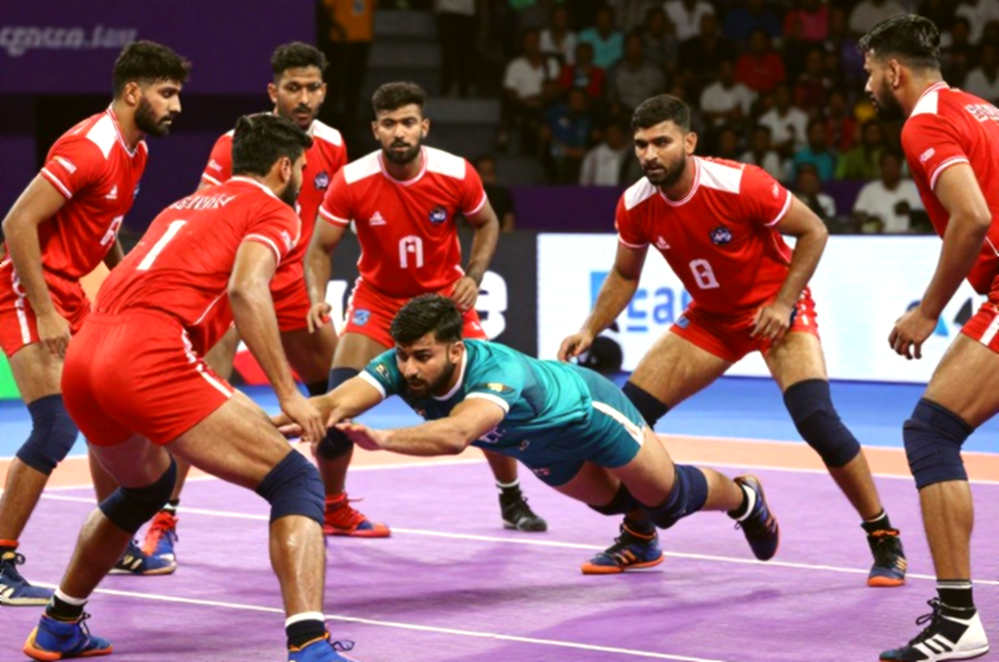
Kabaddi's point economy is simple and its consequences are violent. A successful raid, a tackle, a bonus — each is a separate point. And when all seven defenders of a side are out, the opposition gets the two all-out points and the seven out players revive. That revival rule is what builds margins. Once a collapse starts it does not stop easily: seven men return, but they return with a broken structure.
So Iran's 83-27 is not the sum of 56 excellent raids. It is the repetition of a structural collapse — Thailand losing seven men again and again, returning, and walking into the same trap. That spiral is not built in the first ten minutes. It is built when the result is effectively settled, when raiders start deciding faster, and the defence's seven-man cover frays — one man steps early, one reacts a second late, two end up on the same line at the back.
In other words, score difference mostly accounts for the minutes in which the match has no future left. A match winnable by 15 can be pushed to 25 in the last two minutes — and under tournament rules those extra ten points are not entertainment, they are a medal.
Nepal's only win is the strangest illustration. On the final day, with no semi-final hope left, they beat Malaysia 73-52. The most meaningless match of the tournament produced the second-largest margin of the day. That margin took Nepal nowhere; but for the three teams in Group A, precisely this kind of dead-time point became the final judgment.
Wins bank; margins leak
Two things need separating in this table. A win is a bank — it does not vanish on the last day, and it does not lose value when the opponent changes. A margin is weather — it accumulates at the end of a match, but if the group changes, the rule changes, the opponent changes, it is worth nothing.
Thailand were demolished by 56 points by Iran and still go home with a medal, because they had banked three wins. In Group A, three teams stood level on two wins, and with identical deposits they walked into the market of margins, where a single session can flip everything.
Bangladesh deserve no small reading. Apart from India, nobody in Group A won more than two matches, and there was no free fixture in that group. But stopping at two wins in the third row points to a specific pattern: those matches stayed alive into the last five minutes. A team that cannot close a match early finds the arithmetic failing at the end. The scoresheet goes quiet here, because it cannot say what decision was made in the raiding circle in the final ninety seconds. The ledger never lied, but it never told the whole story either.
In 2026 in Jayanagar I wrote a season of Bengaluru FC into a handwritten ledger and had to invent a column — 'second-ball wins' — because I had no detailed attacking data. That habit still travels with me: the column you do not set yourself is the column that later removes you from the table. In kabaddi that missing column might be 'how many minutes the match stayed alive', or 'all-outs conceded in the last ten minutes'.
I watched these matches on a phone stream two thousand kilometres from Bangladesh. The stream runs two or three seconds behind, and on a small screen the defenders' footwork is almost invisible. What does come through is fear — when a side does not know whether two wins are enough, every raid changes character. Under these rules players cannot know the score-difference picture live; the table only becomes meaningful once every match is over. For four matches a team plays blind, and the fifth column decides its flight home.
Pakistan's zero, Japan's 27, Korea's four defeats
Pakistan's two wins were not enough, because Group B's top two won four and three matches respectively. Pakistan's margin for error was exactly one match, and on the final evening Iran's 51-30 erased even that. For the first time, Pakistan returns from an Asian Games without a kabaddi medal. What their locker room looked like afterwards does not reach a phone screen. The dressing room speaks in pauses, and no camera captures that silence — only the reporter waiting in the corridor does.
Hosts Japan produced their biggest margin on the last day — 27 points against Korea, 62-35. But they sat lowest of the three-way tie in Group A, so those 27 points were only a handsome farewell gift. Hosting fills the stands; it does not fill the points column. For Korea the question runs deeper: four defeats in four matches is not a question of one day's form but of preparation structure.
And one cost sits in no column at all. The appetite for padding a margin in dead time means eight or ten extra raids in the last ten minutes, means a tired raider's hamstring, means an ankle. There is a price for that on the physio's table; there is no cell for it in the analyst's spreadsheet. A coach who pulls a senior raider at 40-25 is making a medical decision — and the tournament rules now punish exactly that decision. The dressing room's ethics and the table's arithmetic are facing each other for the first time, and nobody has said a word about the conflict.
The false conclusion 83-27 invites
The conventional reading now runs like this: Iran destroyed Thailand by 56, India are four from four, so the gold medal match on September 26 is effectively written, and Thailand are merely passengers in the semi-final.
Knockout kabaddi refuses that reading. No aggregate carries into a semi-final; the fifth column is deleted that day. Iran's spiral needs a breaking structure — in the group stage, sides calculate mid-match how much margin to protect, rest senior players, and that is what creates dead time. In a knockout that calculation stops. One match, one evening, no margin left to defend, and therefore none of the empty minutes Iran prefers.
Look at Thailand from the other side. The team that absorbed the tournament's worst defeat is now the one with nothing left to protect — a first medal is already in the pocket. And they have watched Iran's all-out pattern from the mat itself, the cheapest scouting report kabaddi offers. Whether they can use it is a separate question; but predicting a semi-final from a 56-point margin is not honest analysis.
And buried under India's four-from-four is 37-21 — against Chinese Taipei, the only fellow semi-finalist India faced, they conceded 21 points. Chinese Taipei's reward for surviving on score difference is a meeting with the most destructive attack in the tournament. The irony belongs to the rule, not to the players.
Takeaway
Before September 26, I will count one thing: the first five minutes of each semi-final. If Iran can trap an opponent's seven men the same way there, the 56 points were real. If they cannot, it will prove that margin was the arithmetic of an opponent's neglect, not of power.
For Bangladesh the real question is not about reaching a semi-final. It is whether the next cycle treats score difference as misfortune or as tactics. I count the ticks nobody prints, because that is where the real story keeps time.